
Your Freelance Income
| Tax Component | Taxable Base | Amount |
|---|
NYC has more than 800,000 freelancers, making taxes more complex for self-employed workers. Our NYC Freelancer & 1099 Tax Calculator helps estimate your take-home income after self-employment tax, federal income tax, New York State tax, and NYC local taxes, along with your estimated quarterly tax payments.
Whether you work as a freelancer, independent contractor, consultant, gig worker, or other self-employed professional, this calculator can help you understand how much of your income you may actually keep after taxes.
What to Expect as a NYC Freelancer
As a freelancer in NYC, you may pay 35%–50% in total taxes, depending on your income and individual tax situation.
The self-employment (SE) tax alone is 15.3% of net earnings, because you are responsible for both the employer and employee portions of Social Security and Medicare.
Unlike W-2 employees, whose employers cover half of FICA taxes, freelancers are responsible for the full self-employment tax.
On top of self-employment tax, you may also owe:
- Federal income tax: 10%–37%
- New York State income tax: 4%–10.9%
- NYC local income tax: 3.078%–3.876%
These taxes can add up quickly, which is why understanding your estimated take-home income is important for effective tax planning.

NYC Freelancer Tax Burden by Revenue
The following estimates are based on a single filer with $0 in business expenses.
Your actual tax burden may be lower if you qualify for business deductions, credits, or other tax benefits that reduce your taxable income.
| Gross Revenue | SE Tax (15.3%) | Federal | NY State | NYC Local | Total Tax | Take-Home |
| $50,000 | $7,065 | $4,091 | $2,430 | $1,476 | $15,062 | $34,938 (70%) |
| $75,000 | $10,597 | $8,013 | $4,276 | $2,424 | $25,310 | $49,690 (66%) |
| $100,000 | $14,130 | $13,154 | $6,344 | $3,390 | $37,018 | $62,982 (63%) |
| $150,000 | $21,195 | $24,589 | $11,048 | $5,476 | $62,308 | $87,692 (58%) |
| $200,000 | $27,481 | $37,631 | $16,513 | $7,495 | $89,120 | $110,880 (55%) |
Note: These figures are estimates for illustration. Your actual tax liability depends on business expenses, filing status, deductions, credits, and other factors.
Quarterly Estimated Taxes Are Due
Quarterly estimated tax payments are generally due on:
| Quarter | General Due Date |
| 1st Quarter | April 15 |
| 2nd Quarter | June 15 |
| 3rd Quarter | September 15 |
| 4th Quarter | January 15 of the following year |
Freelancers may be required to make separate payments to the IRS, New York State, and New York City.
Failure to make required estimated payments, or underpayment of estimated taxes, can result in penalties that may apply to the amount that was underpaid.
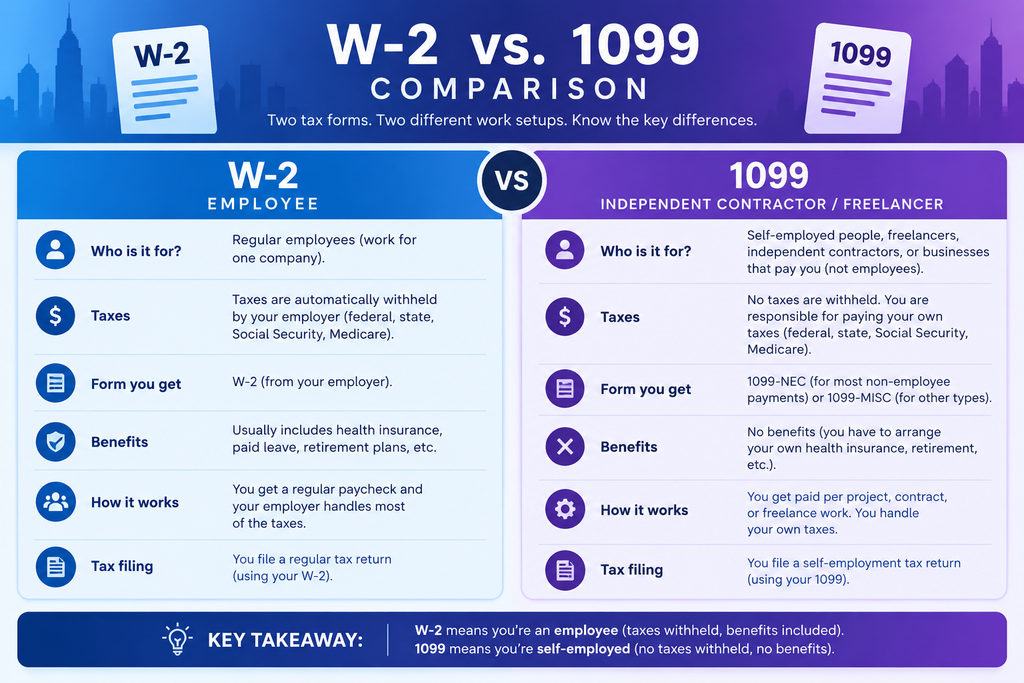
W-2 Employee vs. 1099 Contractor: Same Gross, Very Different Take-Home
One of the biggest differences between W-2 employment and 1099 freelance income is how payroll taxes are handled.
For example, with $100,000 of income, a W-2 employee has an employer paying half of the employee’s FICA taxes.
A 1099 contractor, however, is generally responsible for both portions through self-employment tax.
That difference can represent thousands of dollars in additional tax responsibility for a freelancer.
W-2 vs. 1099
| Feature | W-2 Employee | 1099 Freelancer |
| Tax withholding | Usually handled by employer | Usually no regular withholding |
| FICA | Employer pays half | Freelancer generally pays both portions |
| Business expenses | Limited | Eligible business expenses may be deductible |
| Estimated taxes | Usually not required | Often required |
| Tax planning | Shared with employer | Mostly handled by freelancer |
How Freelancer Taxes Are Calculated
Freelancer taxes are calculated in several stages, and each stage can affect your final tax bill.
1. Net Self-Employment Income
Net SE Income = Gross Revenue − Business Expenses
Your net self-employment income is the amount remaining after subtracting eligible business expenses from your gross freelance revenue.
2. Self-Employment Tax
SE Tax = Net SE Income × 92.35% × 15.3%
This represents the self-employment tax calculation in simplified form, covering both the employee and employer portions of Social Security and Medicare.
3. Self-Employment Tax Deduction
SE Deduction = SE Tax × 50%
Half of the self-employment tax is deductible because employers can generally deduct their share of payroll taxes.
4. QBI Deduction
QBI Deduction = 20% of Net SE Income
The Qualified Business Income deduction is shown here in simplified form. Phase-outs and additional limitations may apply at higher income levels and for certain types of businesses.
5. Federal Taxable Income
Federal Taxable Income = Net SE Income − SE Deduction − QBI Deduction − Federal Standard Deduction
The standard deduction used in the original calculation is:
- $14,600 for Single
- $29,200 for Married Filing Jointly
6. New York State Taxable Income
NY State Taxable Income = Net SE Income − SE Deduction − NY Standard Deduction
The original calculation uses:
- $8,000 for Single
- $16,050 for Married
7. NYC Taxable Income
NYC Taxable Income = Net SE Income − SE Deduction
For NYC tax calculations, this simplified method does not include the QBI deduction.
8. Additional Medicare Tax
Additional Medicare Tax = Amount Above Threshold × 0.9%
Additionally, the Additional Medicare Tax may apply to income above the applicable threshold.
9. Net Investment Income Tax (NIIT)
NIIT = Lesser of (Net Investment Income, MAGI − Threshold) × 3.8%
This applies to eligible investment income when the applicable income thresholds are exceeded.
10. Estimated Quarterly Taxes
Quarterly Amount = (Estimated Annual Tax − Withholding − Credits) ÷ 4
This formula provides a simplified way to estimate quarterly tax payments.
11. Tax Credits
Final Tax Liability = Tax Before Credits − Eligible Tax Credits
Applicable tax credits can reduce your final tax liability.
Freelancer Tax Planning Checklist
Before using the calculator, make sure you have the following information ready:
| Information | Why It Matters |
| Gross freelance revenue | Starting point for the calculation |
| Business expenses | Reduce net business income |
| Filing status | Changes tax calculations |
| W-2 income | Can affect overall tax liability |
| Other income | May affect taxable income |
| Estimated withholding | Reduces remaining tax due |
| Tax credits | Can reduce final liability |
| NYC residency | Can affect NYC local tax |
The more accurate your inputs are, the more useful your estimated result will be.
NYC Freelancer Tax Calculator: Simple Breakdown
Overall, you can calculate the total amount using the following formula:
Gross Freelance Revenue
↓
− Business Expenses
↓
= Net Self-Employment Income
↓
Self-Employment Tax
Federal Income Tax
New York State Tax
NYC Local TaxOther Applicable Taxes
Tax Credits / Adjustments
↓
Estimated Take-Home Income
In addition, this makes it easier to understand where your freelance income goes and how much you may actually keep.
Frequently Asked Questions(FAQs)
Your take-home pay depends on your total income, business expenses, filing status, and the taxes applicable to you. Start with your gross freelance income, deduct eligible business expenses, and then calculate self-employment, federal, New York State, and NYC taxes.
Yes. A freelancer in New York City may face multiple levels of taxation, including federal income tax, self-employment tax, New York State income tax, and New York City local income tax.
Usually, no. Unlike W-2 employees, freelancers generally receive payments without regular tax withholding and therefore need to plan for their own tax payments.
Allowable business expenses can reduce the income upon which your taxes are calculated. For example, $100,000 in freelance revenue with $10,000 in allowable business expenses could result in $90,000 of net business income before other deductions and tax calculations.
Yes. The calculator is designed for freelancers, independent contractors, and self-employed individuals who receive income reported on a 1099 form.
You can have both types of income in the same year. Your W-2 and 1099 income are reported differently, but they can affect your overall federal, New York State, and NYC tax situation.
Yes. Filing status can affect your tax brackets, standard deduction, and overall federal and state tax liability. The result can differ between Single, Married Filing Jointly, and Head of Household.
Even with relatively low freelance income, you may still have tax obligations. Whether self-employment tax or income tax applies depends on your net income and overall tax situation.
Many freelancers use 35%–45% as a budgeting range, while some may need more or less depending on their individual tax situation. Saving around 40% can be used as a starting point until you determine your actual effective tax rate.
Self-employment tax is generally 15.3% applied to 92.35% of net self-employment income, representing both the employee and employer portions of Social Security and Medicare.
Quarterly estimated tax payments are generally due on April 15, June 15, September 15, and January 15 of the following year.
Yes. Eligible business expenses can reduce your net self-employment income before taxes are calculated. Common examples include qualifying home-office costs, equipment, software, professional development, health insurance premiums, and retirement contributions.