
A bonus or Restricted Stock Unit (RSU) award can increase your income, but the amount you receive after taxes may be significantly lower than the amount shown in your compensation package. Federal income tax withholding, New York State tax, New York City tax, Social Security, and Medicare can all affect your final payment.
The NYC Bonus & RSU Tax Calculator helps employees estimate how much of a cash bonus or RSU award they may keep after estimated payroll withholding. It is designed for employees who live in New York City and want a clearer picture of their compensation after taxes.
Use the calculator to estimate your bonus or RSU take-home amount, understand the deductions that may apply, and compare different compensation amounts.
Important: Tax withholding is not always the same as your final tax liability. Your actual tax depends on your annual income, filing status, deductions, credits, payroll history, and other individual circumstances.
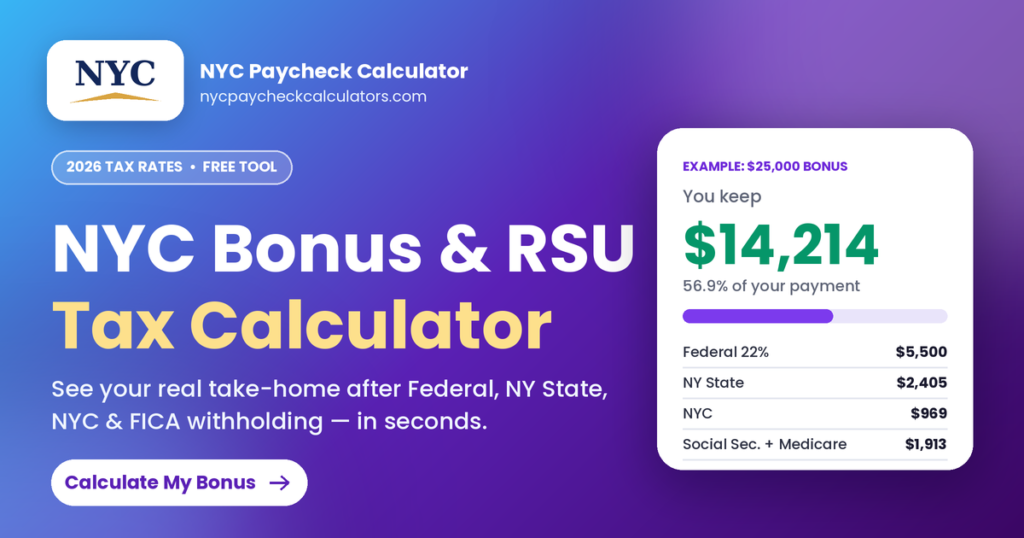
Know Your Real Take-Home Pay
Estimates only. Actual withholding and take-home pay may vary based on tax year, filing status, deductions, credits, and individual circumstances. This calculator is for informational purposes and is not tax advice.
| Tax component | Rate / basis | Estimated withholding |
|---|
How to Use the NYC Bonus & RSU Tax Calculator
You can use the calculator to estimate the taxes and take-home value of a cash bonus or an RSU award.
Follow these steps:
- Select whether you want to estimate a cash bonus or an RSU award.
- Enter your annual salary or regular compensation, if requested.
- Enter the bonus amount or the value of your RSUs.
- Select the applicable filing status and other requested details.
- Enter any additional information requested by the calculator, such as year-to-date wages or Social Security wages.
- Review the estimated tax deductions and take-home amount.
The calculator provides an estimate based on the information entered. Your employer’s payroll method, tax withholding elections, and compensation details may produce a different result.
How Are Bonuses Taxed in New York City in 2026?
A cash bonus is generally treated as supplemental wages. Supplemental wages include compensation paid in addition to regular salary, such as:
- Annual performance bonuses
- Signing bonuses
- Holiday bonuses
- Sales commissions
- Cash awards
- Certain incentive payments
A bonus is generally subject to federal income tax withholding, applicable New York State and New York City income tax withholding, Social Security tax, and Medicare tax.
The important distinction is that a bonus is not automatically taxed at one universal final tax rate. Employers follow specific payroll withholding methods, while your final tax is calculated using your overall tax situation.
2026 Federal Bonus Tax Withholding
For 2026, the federal supplemental wage withholding rate is generally 22% when the employer uses the applicable optional flat-rate method and the payment qualifies for that method.
A special rule applies when supplemental wages paid to an employee by an employer during the calendar year exceed $1 million. The portion above $1 million is subject to 37% federal income tax withholding.
For example, if an employee receives $1,200,000 in qualifying supplemental wages from an employer during the year and has received no other supplemental wages from that employer, the first $1 million may qualify for the 22% flat withholding method, while the $200,000 excess is subject to 37% withholding.
The 37% rate does not automatically apply to the entire $1.2 million payment.
The 22% and 37% figures are federal withholding rates. They do not necessarily represent the employee’s final federal income tax rate.
2026 New York State Bonus Tax Withholding
New York State treats bonuses as supplemental wages for payroll withholding purposes.
When a bonus is paid separately from regular wages, an employer may use an applicable supplemental withholding method if the requirements are met. One available method is the New York State supplemental rate of 11.70% when applicable. An employer may also use the aggregate method.
Under the aggregate method, the bonus is combined with regular wages for the relevant payroll calculation. The employer calculates withholding on the combined amount and subtracts the tax already withheld from regular wages.
If a bonus is paid together with regular wages without separately identifying the amounts, the employer generally calculates withholding as one regular payroll payment.
The applicable method depends on how the payment is made and the employee’s payroll circumstances.
2026 New York City Bonus Tax Withholding
Employees who are subject to New York City resident income tax may also have NYC income tax withholding on bonus payments.
For separately identified supplemental wages, an employer that withholds NYC income tax from regular wages may use the 4.25% NYC supplemental withholding rate or the applicable aggregate method.
The 4.25% figure is a withholding method, not a universal final NYC tax rate. Your actual NYC income tax liability is determined under the applicable tax rules for your annual income and circumstances.
2026 Bonus Tax Withholding Rates at a Glance
Federal
New York State & NYC
Social Security & Medicare
These figures describe withholding rules and payroll taxes. They should not be added together and treated as one guaranteed tax rate for every employee. The actual deductions depend on the payment method, year-to-date wages, payroll history, and applicable tax rules.
Social Security and Medicare Taxes on Bonuses
Bonuses are generally treated as wages for Social Security and Medicare purposes. These taxes are commonly known as FICA taxes.
Social Security Tax
For 2026, the employee Social Security tax rate is 6.2% on covered wages up to the annual Social Security wage base of $184,500.
The wage base applies to the employee’s total covered wages for the calendar year, not separately to each bonus.
If your regular salary has already reached the Social Security wage base before your bonus is paid, additional bonus wages generally will not be subject to employee Social Security tax.
If only part of the wage base has been reached, only the remaining eligible wages are generally subject to Social Security tax.
Medicare Tax
The regular employee Medicare tax rate is 1.45% on covered wages. Unlike Social Security, Medicare tax has no annual wage cap.
This means a bonus is generally subject to Medicare tax even if your salary has already exceeded the Social Security wage base.
Additional Medicare Tax
Employers must begin withholding an additional 0.9% Medicare tax when they pay an employee more than $200,000 in Medicare wages during the calendar year.
This is an employer withholding threshold. Your final Additional Medicare Tax liability is determined separately on your tax return and depends on your filing status and applicable income thresholds.
For this reason, the calculator may need your year-to-date wages to estimate FICA deductions more accurately. Your annual salary alone may not provide enough information.
Bonus Tax Withholding vs. Your Final Tax Bill
One of the most common misunderstandings about bonuses is the belief that the withholding percentage is the final tax rate.
That is not necessarily true.
Federal, New York State, and New York City withholding amounts are payments collected through payroll during the year. Your final tax liability is determined when you file your income tax returns.
For example, an employer may withhold federal income tax from a separately paid bonus using the 22% supplemental wage method. However, your final federal tax depends on your total taxable income, filing status, deductions, credits, and other tax details.
You may receive a refund if too much tax was withheld, or you may owe additional tax if your total withholding was insufficient.
The same general distinction applies to state and city income tax withholding.
Flat-Rate Method vs. Aggregate Method
Employers may use different permitted methods to calculate income tax withholding on supplemental wages.
Flat-Rate Method
Under an applicable flat-rate method, the employer withholds tax from a separately identified supplemental payment using a specified withholding percentage.
This method can make the payroll deduction easier to understand because the withholding is calculated using a set percentage.
However, the flat rate is not necessarily your final tax rate.
Aggregate Method
Under the aggregate method, the employer combines the bonus with regular wages for a payroll withholding calculation.
The employer calculates the withholding as if the combined amount were a regular wage payment, then subtracts the tax already withheld from regular wages.
This method can result in a different withholding amount from the flat-rate method.
The method used depends on federal and state payroll rules, how the bonus is paid, and the employee’s withholding circumstances.
How Are RSUs Taxed in New York City?
Restricted Stock Units, commonly called RSUs, are a form of equity-based compensation offered by many employers.
An employer promises to deliver company shares after certain conditions are met, such as completing a vesting period or meeting performance requirements.
For most standard employee RSU arrangements, the value of shares is generally treated as ordinary wage income when the RSUs vest and the shares are delivered or otherwise become taxable.
Example: Understanding RSU Vesting
Suppose an employee receives 100 RSUs and the company’s stock price is $50 per share when those shares vest.
The value of the vested shares is:
100 shares × $50 = $5,000
The $5,000 generally represents wage income for federal income tax purposes at vesting, subject to the applicable tax rules.
The employer may withhold taxes through cash withholding, share withholding, or a sell-to-cover transaction, depending on the company’s equity compensation plan and brokerage arrangements.
The number of shares withheld or sold is not automatically the same for every employee. It depends on the applicable withholding rates, payroll circumstances, stock price, and plan procedures.
What Happens When RSUs Vest?
A typical RSU vesting process may work as follows:
- The employee reaches the vesting date.
- The vested shares become taxable compensation under the applicable rules.
- The employer calculates required payroll withholding.
- The employer or brokerage platform handles the withholding through the plan’s permitted process.
- The employee receives the remaining shares or proceeds, depending on the plan.
The taxable value at vesting is generally included in wage income. If you later sell the shares, the sale may create a separate capital gain or capital loss based on the difference between the sale price and your tax basis.
RSU Taxation: Vesting vs. Selling Shares
It is important to understand that RSU taxation can involve two separate tax events.
1. Tax When RSUs Vest
When RSUs vest, their value is generally treated as ordinary compensation income.
For example, if 100 shares vest at $50 per share, the taxable compensation value is generally $5,000.
Applicable payroll withholding may include federal, state, city, Social Security, and Medicare taxes.
2. Tax When You Sell the Shares
If you sell your shares after vesting, you may have a capital gain or capital loss.
The difference between your sale proceeds and your adjusted tax basis generally determines the capital gain or loss.
For a straightforward RSU transaction, the tax basis is generally the fair market value included in your wage income at vesting, adjusted where required.
Example:
- RSU value at vesting: $5,000
- Value when shares are later sold: $5,400
- Illustrative difference: $400 gain
The $400 difference may be treated as a capital gain, subject to the applicable tax rules and transaction details.
If the shares are sold for less than their tax basis, the sale may instead produce a capital loss.
Keep your vesting statements, brokerage records, and Form W-2 information so that the compensation income and share sale are reported correctly.
Does a 401(k) Contribution Reduce Bonus Taxes?
Some employers allow employees to contribute part of an eligible cash bonus to a traditional 401(k) plan.
A traditional 401(k) contribution can generally reduce the employee’s federal taxable income for the applicable year, subject to plan rules and contribution limits. State income tax treatment may differ.
However, traditional 401(k) salary deferrals generally remain subject to Social Security and Medicare taxes.
For 2026, the regular employee 401(k) elective deferral limit is $24,500. Employees who qualify for catch-up contributions may be eligible to contribute more, subject to age-based rules and plan requirements.
Your available contribution room depends on your contributions across applicable plans during the year. Check with your plan administrator before assuming that an entire bonus can be contributed.
A 401(k) contribution does not automatically eliminate taxes on a bonus or RSU award.
Why Can My Bonus Take-Home Pay Be Lower Than Expected?
There are several reasons your bonus payment may be smaller than the amount announced by your employer.
- Federal income tax withholding: Your employer may use a supplemental wage withholding method.
- New York State withholding: State income tax may be deducted from the payment.
- NYC income tax withholding: Applicable NYC resident withholding may also reduce the payment.
- Social Security tax: Your bonus may be subject to Social Security tax if you have not reached the annual wage base.
- Medicare tax: Medicare generally applies to covered bonus wages without an annual wage cap.
- Additional Medicare withholding: Your employer may withhold an additional 0.9% after your wages paid by that employer exceed $200,000 for the calendar year.
- Retirement contributions: Your employer may deduct an elected 401(k) contribution if the plan permits it.
- Other payroll deductions: Insurance premiums, benefit deductions, or other authorized deductions may also affect your payment.
A large bonus can therefore have a noticeably different take-home amount from your regular paycheck.
Tips for Estimating Your Bonus and RSU Take-Home Pay
For a more useful estimate, gather the following information before using the calculator:
- Your annual base salary
- Your expected cash bonus amount
- Your RSU grant or vesting value, if applicable
- Your federal filing status
- Your year-to-date Social Security wages
- Your year-to-date Medicare wages
- Your year-to-date supplemental wages, when relevant
- Your 401(k) contribution elections
- Your other applicable payroll deductions
Year-to-date wage information is particularly important for estimating Social Security and Additional Medicare withholding. A calculator that uses only annual salary and bonus amount may not capture these payroll limits accurately.
Frequently Asked Questions
Are bonuses taxed differently from regular salary in NYC?
Bonuses are generally treated as supplemental wages for payroll withholding purposes. Employers may use permitted supplemental wage withholding methods when the bonus is separately identified. The final income tax treatment depends on your total annual income and tax situation.
Is a bonus taxed at 22% in 2026?
The federal supplemental wage withholding rate is generally 22% when the applicable optional flat-rate method is used. This is a withholding rate, not a guaranteed final tax rate. The aggregate method may also apply.
When does the 37% federal bonus withholding rate apply?
The 37% withholding rate applies to the portion of qualifying supplemental wages paid by an employer during the calendar year that exceeds $1 million. It does not automatically apply to the entire bonus.
Does New York City tax bonuses?
Bonuses paid to employees subject to NYC resident income tax withholding may be subject to NYC withholding. For qualifying separately identified supplemental wages, employers may use the 4.25% NYC supplemental withholding method or the applicable aggregate method.
Do bonuses have Social Security and Medicare taxes?
Yes. Bonuses are generally treated as wages for Social Security and Medicare purposes. Social Security tax is subject to the 2026 wage base of $184,500, while regular Medicare tax has no annual wage cap.
Why was Social Security tax not deducted from my bonus?
You may already have reached the annual Social Security wage base through your regular salary or other covered wages. Once the applicable wage base has been reached, additional covered wages generally are not subject to employee Social Security tax for that calendar year.
What is the Additional Medicare Tax threshold for 2026?
Employers generally begin withholding the additional 0.9% Medicare tax when they pay an employee more than $200,000 in Medicare wages during the calendar year. The final tax liability is calculated separately based on the employee’s filing status and applicable income thresholds.
Are RSUs taxed when they are granted or when they vest?
For most standard employee RSU arrangements, the value is generally treated as wage income when the shares vest and become taxable, rather than when the RSUs are initially granted. Specific award terms and tax circumstances can affect the treatment.
Do I pay tax again when I sell RSU shares?
The value of vested RSUs is generally included in wage income at vesting. When you later sell the shares, the difference between the sale proceeds and your tax basis may create a capital gain or capital loss.
Can I use this calculator for a signing bonus?
Yes. A signing bonus is generally a form of supplemental wage compensation. Enter the applicable bonus amount and other requested details to estimate potential withholding and take-home pay.
Can I use this calculator if I live in NYC but work remotely?
The calculator is intended for estimates involving NYC residents. Your actual state and local tax treatment may depend on your residence, work location, employer circumstances, and applicable tax rules. Remote work does not automatically remove New York tax obligations.
Does contributing a bonus to a 401(k) reduce all bonus taxes?
No. Eligible traditional 401(k) contributions may reduce federal taxable income, but they generally remain subject to Social Security and Medicare taxes. State tax treatment and plan rules should also be considered.
Is the calculator’s result my final tax refund or tax bill?
No. The calculator provides an estimate of payroll withholding and take-home compensation. Your final tax liability is calculated when you file your tax returns using your total income, deductions, credits, filing status, and other relevant information.
How accurate is the NYC Bonus & RSU Tax Calculator?
The estimate depends on the accuracy and completeness of the information entered. Year-to-date wages, payroll withholding methods, filing status, RSU vesting details, and other deductions can all affect the result. Your employer’s actual payroll statement and final tax return may differ from the estimate.
Official Tax Resources for 2026
For the latest tax rules and payroll withholding guidance, consult these official resources:
- IRS Publication 15 (2026): Employer’s Tax Guide — Federal supplemental wage withholding, Social Security, and Medicare rules.
- IRS Publication 15-A (2026): Employer’s Supplemental Tax Guide — Additional guidance on supplemental wages and employment taxes.
- New York State Department of Taxation and Finance — New York State income tax and withholding information.
- New York City Withholding Tax Tables and Methods (2026) — NYC payroll withholding methods, including supplemental wages.
- IRS 401(k) Contribution Limits — Current retirement plan contribution limits.
Disclaimer
This calculator and its accompanying information are provided for educational and informational purposes only. The results are estimates and should not be considered tax, legal, financial, or investment advice.
Actual bonus and RSU tax treatment may vary depending on your income, filing status, residence, payroll history, employer withholding methods, equity compensation plan, deductions, and applicable federal, state, and local tax rules.
Tax withholding is not necessarily the same as final tax liability. Consult a qualified tax professional or payroll specialist for advice about your individual circumstances.