
Want to know exactly how your paycheck is calculated? You do not need to be a payroll expert to figure it out.
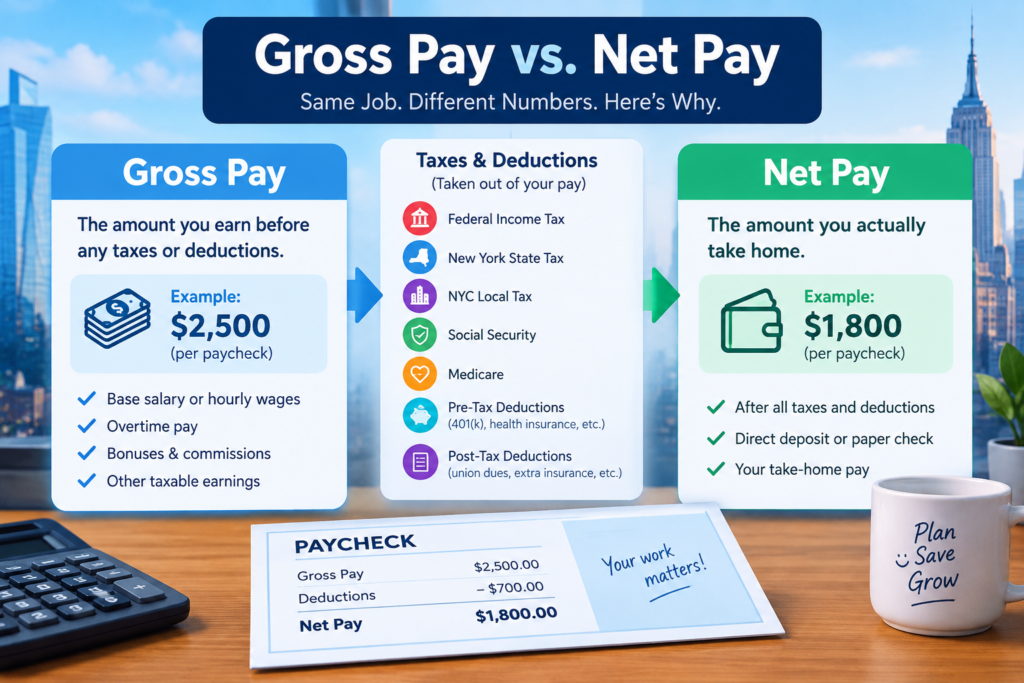
Your paycheck starts with your gross pay—the amount you earn before taxes and deductions. From there, different taxes, benefits, and other deductions are taken out until you reach your net pay, which is the amount that actually reaches your bank account.
If you live or work in New York, your calculation can include federal income tax, Social Security, Medicare, New York State tax, and New York City tax.
This guide walks you through the entire process in simple steps.
Quick answer:
Net Pay = Gross Pay − Pre-Tax Deductions − Taxes − Post-Tax Deductions + Reimbursements
If you want to skip the manual math, you can also use our [New York Paycheck Calculator] to estimate your take-home pay.
What Is Gross Pay?
Gross pay is the money you earn before anything is taken out of your paycheck.
How you calculate it depends on how you are paid.
If You Are Paid a Salary
Divide your annual salary by the number of paychecks you receive each year.
For example, if your salary is $65,000 and you are paid every two weeks:
$65,000 ÷ 26 = $2,500
Your gross pay is approximately $2,500 per paycheck.
If You Are Paid Hourly
Multiply your hourly rate by the number of hours you worked.
For example:
$25 × 40 hours = $1,000
Your gross pay for that week is $1,000 before taxes and deductions.
If you work overtime, bonuses, commissions, or receive other taxable compensation, those amounts may also affect your gross or taxable wages.
For a more detailed explanation, see our guide to [Gross pay vs Net pay].
Step 1: Start With Your Gross Pay
Before calculating taxes, find your gross pay for the specific pay period.
Common pay schedules include:
| Pay Schedule | Paychecks Per Year |
|---|---|
| Weekly | 52 |
| Biweekly | 26 |
| Semi-monthly | 24 |
| Monthly | 12 |
For example, someone earning $78,000 per year and getting paid biweekly would start with:
$78,000 ÷ 26 = $3,000 gross pay
That $3,000 is not the amount they take home. It is simply the starting point.
Step 2: Check Your Pre-Tax Deductions
Some deductions are taken from your paycheck before certain taxes are calculated.
Common examples include:
- Traditional 401(k) contributions
- Health insurance
- HSA contributions
- FSA contributions
- Certain commuter benefits
For example, suppose your gross pay is $3,000 and you contribute $180 to a traditional 401(k).
Your remaining amount for certain income-tax calculations may be lower than your original $3,000.
But there is an important detail:
Not every pre-tax deduction is treated the same way for every tax.
This is one reason a manual calculation can become confusing. The source material also highlights that deductions can have different treatment for income tax and FICA.
Step 3: Calculate Social Security and Medicare
These are commonly grouped together as FICA taxes.
For employees, FICA generally includes:
- Social Security
- Medicare
Your paycheck may show these as separate deductions.
Social Security
Social Security tax applies to wages up to the applicable annual wage limit.
Medicare
Medicare tax generally applies to wages without the same Social Security wage cap.
Higher-income employees can also have an additional Medicare tax.
Because these calculations can change based on your wages and situation, check the current-year rules when doing an exact calculation. The competitor sources also distinguish employee FICA withholding from employer payroll taxes.
Step 4: Calculate Federal Income Tax
Federal income tax is usually one of the biggest deductions from a paycheck.
Unlike a simple flat percentage, federal income tax depends on several factors, including:
- Your income
- Filing status
- W-4 information
- Eligible deductions or adjustments
- Pay frequency
- Other withholding instructions
This means two people earning the same salary can have different federal withholding.
For an exact paycheck calculation, your Form W-4 information matters. The source article specifically identifies filing status and W-4 information as inputs used in paycheck calculations.
Step 5: Calculate New York State Tax
If you work in New York, you may also have New York State income tax withheld from your paycheck.
Your actual withholding depends on factors such as your income and filing information.
This is where a New York paycheck calculation becomes different from a basic federal paycheck calculation.
If you want to understand the bigger picture, see our guide to [New York paycheck deductions].
Step 6: Don’t Forget New York City Tax
If you are a New York City resident, your paycheck may also be affected by New York City personal income tax.
That means a NYC paycheck can involve several layers:
Gross Pay → Federal Tax → Social Security → Medicare → NY State Tax → NYC Tax → Other Deductions → Net Pay
This is one of the main reasons your take-home pay can be significantly lower than your advertised salary.
If you’re specifically interested in NYC taxes, check our [NYC Tax Calculator] guide.
Step 7: Subtract Post-Tax Deductions
Not every deduction happens before taxes.
Some deductions are taken after taxes have been calculated.
Depending on your situation, these can include certain:
- Insurance deductions
- Retirement or savings deductions
- Garnishments
- Other employee-authorized deductions
The important thing is to check your pay stub carefully and identify which deductions are pre-tax and which are post-tax.
Step 8: Add Any Reimbursements
If your employer reimburses you for an eligible work expense, that amount may appear on your paycheck.
Examples can include:
- Business mileage
- Certain work-related purchases
- Approved travel expenses
- Other reimbursable business costs
The reimbursement portion is separate from the basic tax calculation and can affect the amount you receive.
Step 9: Find Your Net Pay
Now you can put everything together.
Simple Paycheck Formula
Gross Pay
− Pre-Tax Deductions
− Federal Income Tax
− Social Security
− Medicare
− NY State Tax
− NYC Tax
− Post-Tax Deductions
- Reimbursements
= Net Pay
Simple Example: $65,000 New York Salary
Let’s make the process easier to understand.
Suppose you earn:
Annual salary: $65,000
Pay schedule: Biweekly
Paychecks: 26 per year
First:
$65,000 ÷ 26 = $2,500
So your gross paycheck starts at $2,500.
Now imagine you have:
- A traditional 401(k) contribution
- Health insurance
- Social Security
- Medicare
- Federal income tax
- New York State tax
- NYC tax
Each applicable amount is deducted according to the rules for that tax or deduction.
What remains is your take-home pay.
The exact result depends on your filing status, W-4 information, deductions, location, and other circumstances, so the $2,500 gross amount should not be treated as your final paycheck.
Why Your Paycheck May Be Different From Someone Else’s
Two people can have the same salary but receive different take-home pay.
For example, one person may contribute more to a 401(k), while another may pay more for health insurance.
Your paycheck can also change because of:
- Filing status
- W-4 elections
- Pay frequency
- Retirement contributions
- Health insurance
- HSA/FSA contributions
- Bonuses
- Overtime
- NYC residency
- Other deductions
That’s why looking only at your annual salary doesn’t tell you how much money you’ll actually receive.
Gross Pay vs. Net Pay: What’s the Difference?
This is one of the easiest paycheck concepts to remember.
Gross pay = what you earn before deductions.
Net pay = what you take home after deductions and taxes.
For example:
$65,000 salary ≠ $65,000 take-home pay
Your $65,000 is your annual gross salary. Your actual take-home amount is lower because applicable taxes and deductions are removed from your paychecks.
How to Check Your Paycheck Manually
If you want to compare your own calculation with your pay stub, check these items:
1. Check your gross pay
Make sure your salary, hourly rate, hours, overtime, and other earnings are correct.
2. Check your taxes
Look for federal income tax, Social Security, Medicare, and applicable state/local taxes.
3. Check your benefits
Review health insurance, retirement contributions, HSA/FSA, and other deductions.
4. Check your net pay
The final number should match the amount actually paid to you, subject to any timing or payment differences.
5. Compare year-to-date amounts
Your pay stub normally includes YTD totals, which can help you spot an unexpected change.
Why Manual Paycheck Calculations Can Be Difficult
The basic math is easy.
The difficult part is knowing which amount each tax or deduction should use.
For example, a deduction may reduce taxable wages for one purpose but not another. The competitor material specifically points out that treating all pre-tax deductions identically for FICA purposes can produce an incorrect result.
That’s why a paycheck calculator can be useful when you simply want a quick estimate.
Want to Calculate Your NYC Take-Home Pay?
Instead of doing every calculation by hand, enter your salary, pay frequency, filing status, and deductions into our [New York Paycheck Calculator].
It can give you a quick estimate of your:
- Gross pay
- Federal taxes
- Social Security
- Medicare
- New York State tax
- NYC tax
- Deductions
- Estimated net pay
- Calculate Your New York Paycheck →
Final Takeaway
Calculating a paycheck manually is really about following the right order.
Start with your gross pay, identify your pre-tax deductions, calculate applicable FICA and income taxes, subtract post-tax deductions, add any applicable reimbursements, and what remains is your estimated net pay.
If you’re in New York City, the calculation can involve several layers of tax, so using a dedicated calculator can save time and make the numbers easier to understand.
Try our New York Paycheck Calculator to estimate your 2026 take-home pay.
Disclaimer: This article is for educational purposes only. Paycheck withholding varies by individual circumstances and current federal, New York State, and NYC rules. For an exact payroll or tax determination, consult your employer, payroll professional, or qualified tax advisor.